
What Is Transportation Insurance? 2026 Guide


TL;DR:
Transportation insurance is essential for legally operating and accessing freight markets, covering goods and passengers across all transport modes. It involves multiple policy layers, including liability, cargo, and physical damage, tailored to specific shipment phases and risk profiles. Proper coverage beyond regulatory minimums ensures market access, financial protection, and ongoing business continuity.
Transportation insurance is defined as specialized commercial coverage that protects the movement of goods and passengers from risks including damage, theft, liability claims, and operational disruptions across road, rail, air, and sea. The industry term you will encounter most often is “commercial transportation insurance,” though the broader phrase covers everything from a single owner-operator truck to a multinational freight network. Understanding what is transportation insurance means recognizing it as both a legal requirement and a market access tool. Without it, a carrier cannot legally operate interstate routes, and most major shippers will refuse to work with you regardless of your safety record.
What is transportation insurance and what does it cover?
Transportation insurance is coverage protecting transit of goods and people via road, rail, air, and sea against theft, fire, accidents, vandalism, and natural disasters during pickup, transit, and delivery phases. That definition matters because it tells you the coverage follows the cargo or passenger, not just the vehicle. A standard auto policy does not do that.

The coverage offered by transportation insurance spans three distinct phases of every shipment: loading, transit, and delivery. Each phase carries its own risk profile. A forklift accident during loading is a different claim than a highway collision during transit, and both differ from a theft at the delivery dock. Policies written specifically for transportation account for all three.
For businesses moving freight, the core protections typically include cargo loss or damage, third-party bodily injury, property damage liability, and physical damage to the vehicle itself. For businesses moving people, such as charter bus operators or medical transport providers, passenger liability takes priority. The role of insurance in logistics extends beyond simple risk transfer. It determines which lanes you can operate in and which contracts you can sign.
What types of transportation insurance exist?
Commercial trucking insurance typically begins with commercial auto liability, then adds cargo insurance for freight and workers’ compensation where required, with many carriers expanding further to include general liability, physical damage, and umbrella coverage. Each layer addresses a different exposure. Buying only the minimum leaves significant gaps that can end a business after a single serious claim.
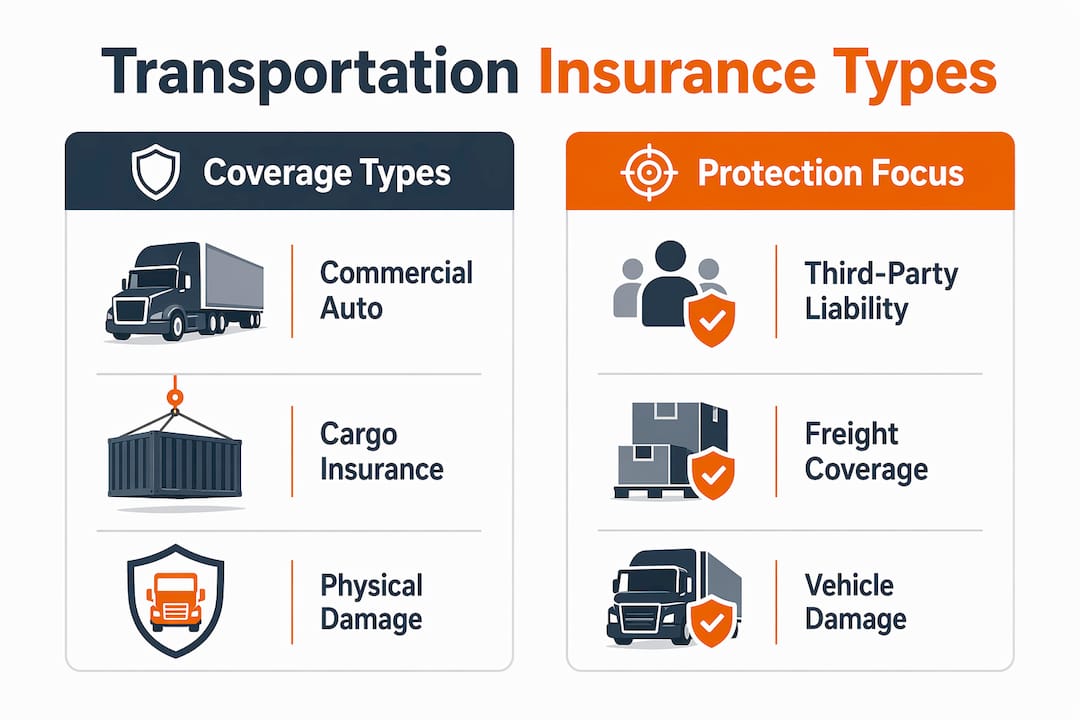
Here is how the major policy types compare:
Coverage Type | What It Protects | When It Is Required |
Commercial Auto Liability | Third-party bodily injury and property damage from vehicle accidents | Required by FMCSA for interstate carriers |
Cargo Insurance | Freight lost, stolen, or damaged during transit | Required by most broker and shipper contracts |
Workers’ Compensation | Driver and employee injuries on the job | Required by most states |
General Liability | Non-auto incidents at terminals, warehouses, or customer sites | Often required by shipper contracts |
Physical Damage | Damage to your own trucks and trailers | Required by lenders; strongly recommended otherwise |
Umbrella / Excess Liability | Coverage above primary policy limits | Required by high-value shippers and large brokers |
Commercial auto liability is the foundation. The Federal Motor Carrier Safety Administration (FMCSA) requires interstate for-hire carriers to maintain minimum public liability limits, and for many property carriers that minimum is $750,000 in coverage. That number sounds large until you consider that a serious multi-vehicle accident on an interstate can generate claims well above that threshold.
Cargo insurance protects the freight itself. Inland marine policies are the standard vehicle for domestic cargo coverage. They follow the goods from origin to destination regardless of which carrier handles the final mile. Specialized endorsements such as reefer spoilage coverage apply when you haul temperature-sensitive loads like pharmaceuticals or fresh produce.
Physical damage coverage splits into two parts: collision, which pays for damage from accidents, and comprehensive, which covers theft, fire, hail, and other non-collision events. Lenders require it on financed equipment, but even owner-operators who own their trucks outright should carry it. Replacing a Class 8 truck out of pocket is not a recoverable expense for most small carriers.
Umbrella and excess liability policies sit above your primary limits. Transportation insurance is multi-layered, involving federal and state law mandates, broker and shipper contract requirements, and optional protections such as equipment coverage or specialized cargo endorsements. Large shippers routinely require $1,000,000 or more in cargo coverage and $2,000,000 or more in auto liability before they will add a carrier to their approved list.
Pro Tip: Before signing any broker or shipper contract, read the insurance requirements section first. Many carriers discover mid-negotiation that their current limits fall short, which delays the start date and costs them the load.
Why is transportation insurance important for businesses?
Transportation insurance is important because it protects against financial loss, satisfies federal and state legal mandates, and determines your ability to access freight markets. Those three reasons are not equal in urgency. Regulatory compliance comes first because losing your operating authority shuts down revenue immediately.
Federal laws mandate three core protections for transportation businesses: vehicle liability, employee injury coverage, and environmental restoration insurance. Missing any one of them puts your operating authority at risk. The FMCSA does not issue warnings before suspending a carrier’s authority for non-compliance.
The financial stakes extend beyond fines. Consider what happens when an uninsured carrier causes a serious accident. The carrier faces direct liability for medical costs, vehicle repairs, legal fees, and potential punitive damages. A single catastrophic claim can exceed $10,000,000 when fatalities or permanent injuries are involved. No small carrier survives that exposure without insurance.
The market access dimension is equally significant. Businesses may legally operate with lower insurance limits, but major brokers and shippers often require higher coverage, effectively setting market entry barriers. This means your insurance program is not just a safety net. It is your credential for doing business with the customers who pay the best rates.
Key reasons transportation insurance matters for your operation:
Regulatory compliance: FMCSA and state agencies require specific minimums to issue and maintain operating authority.
Contract eligibility: Most freight brokers and direct shippers specify minimum coverage levels in their carrier agreements.
Financial protection: Cargo claims, accident liability, and equipment losses can each individually exceed a small carrier’s annual revenue.
Business continuity: Physical damage coverage keeps your trucks moving after an accident instead of sitting idle while you finance repairs.
Employee protection: Workers’ compensation covers drivers injured on the job, reducing your direct liability and meeting state law requirements.
Pro Tip: Do not treat the FMCSA minimum as your target. Treat it as your floor. Most profitable freight lanes require coverage levels that exceed federal minimums by a significant margin.
What factors affect the cost of transportation insurance?
Monthly insurance costs for single-truck operations typically range from $750 to $2,500 or more per power unit, influenced by state, driver experience, operating radius, commodities hauled, and loss history. That range is wide because underwriters treat each of those variables as a separate risk signal. A 25-year-old driver with two years of CDL experience hauling hazardous materials across multiple states will pay significantly more than a 45-year-old driver with a clean record hauling dry goods regionally.
Here are the primary cost drivers ranked by impact:
Driver history and experience. Carriers with drivers who have recent at-fault accidents, DUI convictions, or moving violations pay substantially higher premiums. Some insurers will decline coverage entirely for certain violation types.
Commodities hauled. Hazardous materials, high-value electronics, and temperature-sensitive freight all carry higher cargo rates. Dry van freight hauling general commodities is the most affordable to insure.
Operating radius and states. Interstate operations cost more than intrastate. Certain states with high litigation rates, such as California and Florida, add a geographic surcharge to premiums.
Loss history. A carrier with prior cargo claims or liability losses will pay more. Underwriters typically review the past three to five years of claims history.
Coverage limits and deductibles. Higher limits cost more. Higher deductibles reduce premiums but increase your out-of-pocket exposure per claim.
Fleet size and equipment age. Older trucks with higher mileage present greater breakdown and accident risk. Newer equipment with safety technology such as dashcams and electronic logging devices (ELDs) can qualify for discounts.
Optional add-ons also affect the total premium. Reefer breakdown coverage, trailer interchange agreements, and non-trucking liability each add cost but address specific exposures that a base policy leaves open. Review the insurance requirements for trucking companies before assuming your base policy covers every scenario your operation faces.
Managing costs requires more than shopping for the lowest quote. Investing in driver training programs, maintaining clean MVRs across your fleet, and installing dashcam systems all signal lower risk to underwriters. Carriers who document their safety culture consistently receive better renewal rates than those who rely solely on a clean claims history.
How do you choose the right transportation insurance policy?
Choosing the right transportation coverage starts with a clear picture of your operation: what you haul, where you operate, how many vehicles you run, and what your contracts require. Those four inputs determine your minimum coverage structure before you speak to a single licensed broker.
Follow these steps to select and maintain coverage that actually protects your business:
Map your legal requirements first. Identify your FMCSA authority type and the corresponding minimum liability limits. Confirm which states you operate in and whether any impose additional requirements beyond federal minimums.
Read every contract before quoting. Broker and shipper agreements specify coverage types and minimum limits. Collect those requirements before approaching insurers so you quote the right program from the start.
Work with a licensed broker who specializes in transportation. General commercial insurance brokers often lack the market access and underwriting knowledge specific to trucking and freight. A specialist broker knows which carriers will write your commodity type and operating profile.
Verify BMC-91X filing status. Failing to maintain proper insurance filings such as BMC-91X leads to rapid loss of operating authority, regardless of policy payment status. Confirm your broker files this form with the FMCSA on your behalf and that it stays current at every renewal.
Review coverage annually. Your operation changes. Adding a new truck, hiring a new driver, or taking on a new commodity type all create coverage gaps if your policy is not updated. Schedule a formal review 60 days before each renewal.
Avoid coverage gaps between policies. When switching insurers, confirm the new policy effective date overlaps with the old policy cancellation date by at least one day. A single day without coverage can trigger an FMCSA authority suspension.
The trucking company insurance guide from Insuaria covers common pitfalls in policy selection and renewal in detail. The most frequent mistake carriers make is treating insurance as a one-time purchase rather than an ongoing compliance obligation.
Pro Tip: Ask your broker to provide a coverage gap analysis at every renewal. This is a written comparison of your current policy against your active contracts and FMCSA requirements. It takes 30 minutes and can prevent a six-figure uncovered claim.
Key takeaways
Transportation insurance is a compliance-first requirement that also functions as your primary credential for accessing freight markets and protecting your business from catastrophic financial loss.
Point | Details |
Core definition | Transportation insurance covers goods and passengers against damage, theft, liability, and loss across all transport modes. |
Policy layers matter | Start with commercial auto liability and cargo, then add workers’ comp, general liability, physical damage, and umbrella as contracts require. |
Compliance is non-negotiable | FMCSA requires BMC-91X filings; missing them causes immediate authority loss even if your underlying policy is active. |
Cost varies widely | Single-truck premiums range from $750 to $2,500 or more per month based on driver history, commodities, and operating radius. |
Market access depends on coverage | Major brokers and shippers set coverage minimums above legal requirements, making adequate insurance a condition of doing business. |
The gap nobody talks about enough
Most articles on transportation insurance stop at listing coverage types and quoting premium ranges. That is useful, but it misses the insight that actually changes how carriers operate.
The real challenge is not finding insurance. It is understanding that your insurance program has two separate audiences: the FMCSA and your freight customers. The FMCSA cares about minimum compliance. Your freight customers care about whether you can cover their cargo value and their liability exposure if something goes wrong. Those two audiences have very different standards, and the gap between legal minimums and market demands is where most new carriers get caught.
I have seen carriers launch with exactly the FMCSA minimum, land their first broker agreement, and then discover the broker requires $100,000 in cargo coverage while their policy caps at $25,000. The load does not move. The carrier scrambles to upgrade mid-contract. That scramble costs time, money, and sometimes the relationship.
The smarter approach is to treat insurance as a market positioning tool from day one. Know what the top-tier brokers in your target freight lanes require. Build your coverage program to meet those standards before you start soliciting loads. You will pay slightly more upfront, but you will access better-paying freight immediately instead of being limited to the spot market loads that accept minimum-coverage carriers.
For experienced carriers, the lesson is about renewal discipline. Operations grow. Commodities change. Drivers turn over. A policy that was perfectly calibrated 18 months ago may have three or four gaps today. The carriers who avoid painful claims are the ones who treat their annual renewal as a full audit, not a rubber stamp.
Insurance should be viewed as a compliance-first tool essential for securing operating authority and market access. That framing changes how you budget for it, how you negotiate with brokers, and how you present your operation to shippers. It is not overhead. It is infrastructure.
— Guyorguy
How Insuaria helps you organize your transportation insurance
Getting your transportation insurance program right starts with having your information organized before you talk to a licensed professional.
Insuaria is a compliance-first intake and referral platform built for individuals, trucking businesses, and fleet operators who want to simplify that first step. Through straightforward intake forms, Insuaria helps you organize the details a licensed insurance professional needs to review your coverage, from your operating authority type to your commodity profile and contract requirements. When you submit your business insurance intake through Insuaria, a licensed agency partner follows up to handle quotes, coverage decisions, and recommendations. Insuaria does not bind coverage or issue quotes directly. It makes the process faster, more organized, and less confusing from the start. You can also use Insuaria’s truck insurance quote tool to get started on the auto side of your coverage needs.
FAQ
What is transportation insurance in simple terms?
Transportation insurance is commercial coverage that protects goods or passengers from loss, damage, theft, and liability claims while in transit by road, rail, air, or sea. It follows the cargo or passenger through pickup, transit, and delivery.
Is transportation insurance required by law?
Yes, for interstate for-hire carriers, the FMCSA requires minimum public liability coverage and proof of coverage through BMC-91 or BMC-91X filings to maintain operating authority. State laws add additional requirements for intrastate operations.
How much does transportation insurance cost per month?
Monthly premiums for a single-truck operation typically range from $750 to $2,500 or more per power unit, depending on driver history, commodities hauled, operating radius, and loss history.
What is the difference between cargo insurance and commercial auto liability?
Commercial auto liability covers third-party bodily injury and property damage caused by your vehicle. Cargo insurance covers the freight itself if it is lost, stolen, or damaged during transit. Most carriers need both.
What happens if i let my transportation insurance lapse?
Failing to maintain proper insurance filings such as BMC-91X results in immediate loss of operating authority, even if you have paid your premium. Reinstatement requires refiling and can take days, during which you cannot legally haul freight.
Recommended
Comments