
What Is a Liability Waiver? A Guide for Business Owners


TL;DR:
A liability waiver is a binding contract where participants agree not to sue providers for injuries related to specific activities. Its enforceability depends on clear language, proper presentation, and lawful scope, especially excluding gross negligence and misconduct. Waivers are a defense, not immunity, and should be complemented by adequate insurance and regular updates.
A liability waiver is a legally binding contract where a person voluntarily gives up the right to sue a provider for injuries or losses tied to a specific activity. Also called an exculpatory clause or hold harmless agreement, it shifts risk from the provider to the participant before any injury occurs. Liability waivers function as a defense, not as blanket immunity. Gyms, youth sports leagues, adventure parks, and equipment rental companies rely on them daily. Understanding the definition of liability waiver, its legal limits, and how to draft one correctly is the difference between real protection and a false sense of security.
What is a liability waiver and how does it work?
A liability waiver is a pre-injury written agreement where a participant agrees not to sue a provider for harms typically related to ordinary negligence. The key word is “pre-injury.” A waiver is signed before the activity happens, not after. That distinguishes it from a settlement agreement, which resolves an existing dispute.

The waiver works by transferring risk. The participant acknowledges the dangers of an activity and agrees to absorb those risks rather than hold the provider responsible. A rock climbing gym, for example, asks every member to sign before their first session. A youth soccer league collects signed forms from parents before the season starts. A skydiving company requires a signature before anyone boards the plane.
Tools like DocuSign waiver templates have made this process faster and more consistent. Digital execution reduces the chance of missing signatures or lost paperwork. Platforms like WaiverSign also specialize in collecting and storing signed waivers for high-volume businesses.
The waiver does not eliminate all legal risk. Courts treat it as a defense the provider can raise if sued. Whether that defense holds depends on how the waiver was written, how it was presented, and what state law applies.
What are the essential elements of a liability waiver?
A valid liability waiver form must meet standard contract requirements: offer, acceptance, and consideration. Consideration means each party gives something of value. The participant gets access to the activity; the provider gets the release of liability. Without all three elements, no enforceable contract exists.
Beyond contract basics, a well-structured waiver includes these sections:
Party identification. Full legal names of the participant and the provider or organization.
Activity description. A clear, specific description of the activity covered by the waiver.
Assumption of risk. An explicit statement that the participant understands and accepts the known risks.
Release of liability. The core clause where the participant agrees not to sue for ordinary negligence.
Indemnity clause. An agreement by the participant to cover costs if a third party sues the provider because of the participant’s actions.
Severability clause. A provision stating that if one part of the waiver is voided, the rest remains in force.
Signature and date. Signed by the participant, and for minors, by a parent or legal guardian.
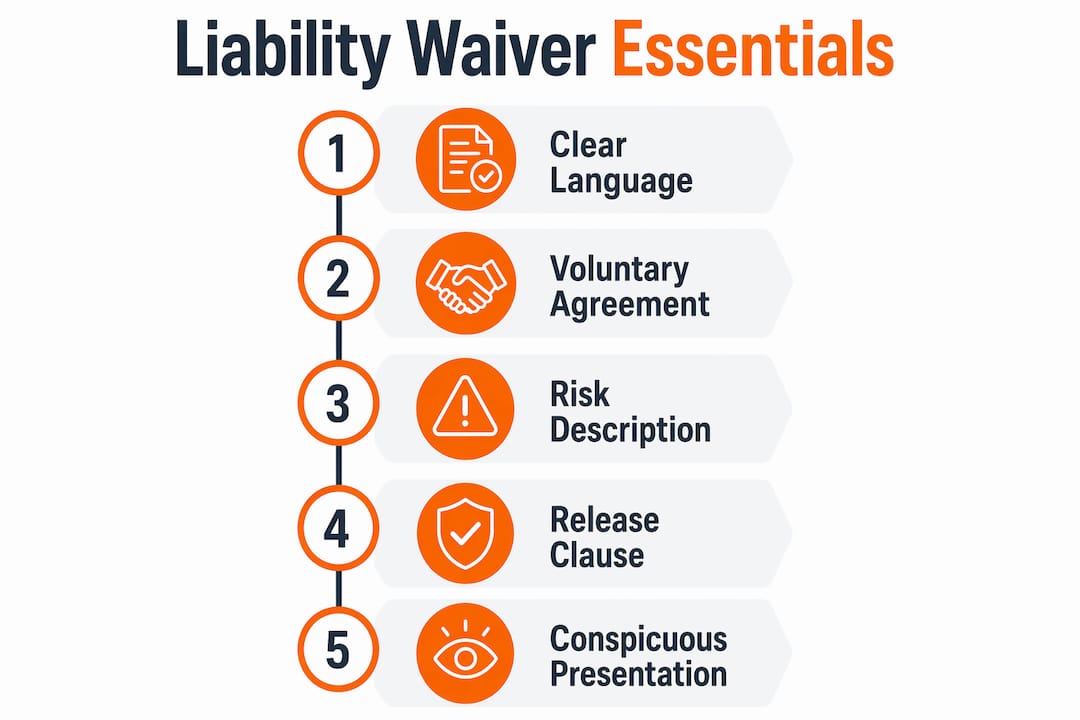
The enforceability of a waiver depends directly on how clearly these elements are written and how prominently they appear in the document. Burying the release clause in small print inside a longer contract is a common mistake that courts penalize.
Pro Tip: Use a bold, separate heading for the release of liability clause. Courts consistently give more weight to exculpatory language that stands out visually from the rest of the document.
The DocuSign liability waiver template expresses all of these elements explicitly and is a useful reference for structuring your own form. Reviewing a professionally drafted template before writing your own saves time and reduces drafting errors.
How enforceable are liability waivers and what are their legal limits?
U.S. courts enforce exculpatory clauses only when they are clear, voluntary, and lawful. Waivers fail to protect providers from gross negligence, recklessness, or intentional misconduct. That is the most important legal limit every business owner needs to understand.
The distinction matters in practice. Ordinary negligence is a failure to exercise reasonable care. Gross negligence is a conscious disregard for safety. If a gym fails to inspect equipment and a cable snaps, that may be ordinary negligence covered by a waiver. If the gym knew the cable was frayed for months and ignored it, that crosses into gross negligence. No waiver covers that.
Courts also apply public policy limits. The Tunkl framework, developed in California and adopted in various forms across many states, identifies factors that can void a waiver:
The activity involves a service of great public importance or necessity.
The provider holds a decisive advantage in bargaining power.
The provider offers a service to any member of the public.
The provider uses a standard form contract with no room for negotiation.
The participant is placed under the provider’s control or care.
“Enforceability is influenced by the public importance of the activity and bargaining power; two similar waivers can have different outcomes depending on jurisdiction and context.” — LegalTank
State-specific enforceability rules vary significantly. Virginia enforces waivers broadly. Louisiana and Montana are among the states that restrict or refuse to enforce them in many contexts. A waiver valid in Texas may not hold in New Jersey.
Signing a waiver does not guarantee immunity from all lawsuits. Courts may sever unenforceable clauses while keeping the rest of the document intact. That means a poorly drafted clause can be removed without voiding the entire waiver, but it also means your protection has gaps you may not know about until you are in court.
The validity of liability waivers also depends on how they are presented. A clear and conspicuous presentation carries as much legal weight as the wording itself. Hidden exculpatory clauses are less likely to be enforced.
How to create a liability waiver that holds up legally
Drafting a liability waiver that survives legal scrutiny requires more than copying a template. The process demands attention to specificity, presentation, and execution.
Follow these steps:
Describe specific risks, not generic ones. Generic risk disclaimers without naming concrete hazards are legally insufficient. Instead of “participant acknowledges the risks of physical activity,” write “participant acknowledges the risk of falls, equipment failure, and physical contact inherent in indoor rock climbing.”
Make the exculpatory clause conspicuous. Use a bold heading, a separate section, or larger font. Courts consistently enforce clauses that are easy to find and read.
State negligence coverage explicitly. The waiver must say, in plain language, that the participant releases the provider from liability for the provider’s own negligence. Vague language that avoids the word “negligence” often fails in court.
Include an indemnity clause. Combining release of liability with a hold harmless clause shifts additional financial exposure away from the provider. These two clauses have distinct legal effects and should not be confused or merged into one sentence.
Add a severability clause. This protects the rest of the waiver if one section is voided by a court.
Give participants time to read it. Execution failures frequently undermine enforceability. Rushing a signature or burying the waiver inside a longer document weakens your defense.
Secure parental consent for minors. A minor cannot legally sign a binding contract. A parent or guardian must sign on the minor’s behalf, and even then, some states do not enforce parental waivers for minors.
Here is a comparison of strong versus weak waiver language:
Element | Weak language | Strong language |
Risk description | “Participant acknowledges physical risks.” | “Participant acknowledges risks of falls, sprains, and equipment failure during climbing.” |
Negligence coverage | “Participant releases all claims.” | “Participant releases provider from liability for provider’s own negligence.” |
Presentation | Buried in paragraph 12 of a membership agreement. | Separate section with bold heading: “Release of Liability.” |
Minor consent | Signed by the minor. | Signed by parent or legal guardian with printed name and relationship. |
Pro Tip: Have a licensed attorney review your waiver before you use it. A one-time legal review costs far less than defending a lawsuit with an unenforceable document.
For businesses managing liability across service contracts, reviewing how service business liability coverage works alongside waivers gives you a more complete picture of your risk exposure.
When and where are liability waivers used?
Liability waivers appear in any setting where the risk of physical injury or property damage is elevated. The importance of liability waivers in these contexts is not just legal protection. They also communicate risks clearly to participants, which reduces misunderstandings and sets expectations.
Common settings include:
Fitness and gyms. Members sign waivers covering equipment use, personal training, and group fitness classes.
Adventure and outdoor activities. Zip lines, white water rafting, skydiving, and rock climbing operations use waivers as a standard part of the intake process.
Youth sports leagues. Parents sign on behalf of minor children before the season begins.
Equipment rentals. Bicycle, kayak, and ski rental companies use waivers to cover damage and injury during the rental period.
Corporate events and team activities. Employers use waivers for off-site activities involving physical risk.
Transportation services. Bus rental and charter companies include liability terms in their agreements. Understanding terms and conditions in bus rental shows how waivers integrate with broader service contracts.
The consequences of not having a waiver are direct. Without one, a provider has no contractual defense against an ordinary negligence claim. Every injury becomes a potential lawsuit with no pre-agreed risk allocation. For small businesses, a single lawsuit can be financially devastating even if the provider ultimately wins.
Digital signing platforms have reduced the friction of collecting waivers. DocuSign, WaiverSign, and similar tools let businesses send, sign, and store waivers electronically. That eliminates the problem of lost paper forms and creates a timestamped record of consent.
The role of waivers in risk management also connects to insurance. A waiver does not replace liability insurance. It supplements it. A business with both a well-drafted waiver and adequate liability coverage has two layers of protection. A business with only one of those layers is exposed on the other side.
For businesses in logistics and transportation, understanding how insurance and liability interact adds important context to why waivers alone are never enough.
Key takeaways
A liability waiver is a pre-injury contract that shifts risk from provider to participant, but its enforceability depends entirely on clear language, proper presentation, and lawful scope.
Point | Details |
Core function | A waiver shifts risk before injury occurs; it is a defense, not a guarantee of immunity. |
Essential elements | Valid waivers include party IDs, specific risk descriptions, a release clause, and signatures. |
Legal limits | Waivers do not cover gross negligence, recklessness, or intentional harm in any U.S. state. |
Drafting quality | Specific hazard language and conspicuous presentation are as important as the legal wording. |
Execution details | Missing a minor’s guardian signature or burying clauses in fine print can void the entire waiver. |
Why most business owners misread what a waiver actually does
The biggest mistake I see business owners make is treating a signed waiver as a closed case. They file it away and assume they are protected. That assumption is wrong, and it is expensive when tested in court.
A waiver is a starting position in a legal argument, not the end of one. Courts look at the whole picture: how the waiver was presented, whether the participant had a real choice, what the specific language covers, and whether the harm falls within the waiver’s lawful scope. A waiver signed under pressure, buried in a registration packet, or written with vague language gives you a weak starting position.
The second misconception is that a waiver replaces insurance. It does not. I have seen businesses cut corners on liability coverage because they believed their waiver was airtight. Waivers get challenged. Insurance pays claims. You need both.
The third thing most articles skip is the relationship between waivers and customer trust. A well-written waiver, presented clearly and explained honestly, actually builds confidence. It shows the participant that you take safety seriously and that you have thought through the risks. A waiver that feels like a legal trap does the opposite.
My advice: review your waiver form at least once a year. Laws change. Courts issue new rulings. A waiver that was solid in 2022 may have gaps in 2026. Treat it like any other business document that needs maintenance.
— Guyorguy
How Insuaria helps you manage risk before it becomes a claim
Liability waivers are one piece of a larger risk management picture. The other piece is making sure your insurance coverage actually matches your exposure.

Insuaria is a compliance-first intake and referral platform that helps individuals and business owners organize the information licensed insurance professionals need to review their coverage. Whether you run a gym, manage a fleet, or operate a service business, Insuaria’s business insurance intake process makes it easier to get your coverage details in front of the right professionals. You can also review Insuaria’s terms and conditions to understand how the platform manages its own contractual obligations. Insuaria does not provide insurance advice or bind coverage. All coverage decisions are made by licensed professionals after reviewing your submission.
FAQ
What is the legal definition of a liability waiver?
A liability waiver is a written contract where a participant agrees in advance not to sue a provider for injuries or losses caused by ordinary negligence in a specific activity. It functions as a legal defense for the provider, not as absolute immunity.
Can you still sue after signing a liability waiver?
Yes. Signing a waiver does not prevent a lawsuit, especially if the waiver is ambiguous, covers excluded risks like gross negligence, or is deemed unconscionable by a court. Courts may also sever unenforceable clauses while keeping the rest of the document in place.
What makes a liability waiver unenforceable?
A waiver becomes unenforceable when it covers gross negligence or intentional harm, uses vague or hidden language, fails to secure a guardian’s signature for a minor, or violates state public policy rules such as those outlined in the Tunkl framework.
Does a liability waiver replace business insurance?
No. A waiver is a contractual defense that shifts risk before an injury. Business liability insurance pays claims and covers legal costs when a waiver is challenged or fails. Both tools serve different functions and work best together.
What should a liability waiver form always include?
A liability waiver form should always include the names of both parties, a specific description of the activity and its risks, an explicit release of liability for negligence, an indemnity clause, a severability clause, and a dated signature from the participant or their legal guardian.
Recommended
Comments