
Liability Waivers in Trucking: What Fleet Owners Must Know


TL;DR:
Liability waivers in trucking are legal documents that release one party from claims related to injuries or damages.
Their enforceability depends on clear language, compliance with state laws, and proper insurance endorsements; vague or broad waivers often fail in court.
Fleet owners must evaluate the legal validity of waivers, review contracts with legal professionals regularly, and ensure insurance policies match contractual terms.
A liability waiver in trucking is a signed legal document in which one party gives up the right to pursue a claim against another party for injuries, property damage, or financial loss. The role of liability waivers in trucking extends across driver agreements, shipper contracts, and settlement documents, making them one of the most consequential legal tools fleet owners handle. These waivers aim to reduce legal exposure, but they only work when drafted correctly and applied within the boundaries of state law. Get the language wrong, and a waiver that looks airtight on paper can collapse in court. Fleet owners who treat waivers as a formality rather than a legal instrument take on far more risk than they realize.
What is the role of liability waivers in trucking operations?
A liability waiver in trucking is not a single document type. It covers a range of contractual tools, including pre-injury releases, post-accident settlement releases, indemnity clauses, and waivers of subrogation. Each serves a different purpose, and confusing them is one of the most common and costly mistakes fleet operators make.
Pre-injury releases ask a party to waive future claims before any incident occurs. These appear in driver agreements, vendor contracts, and freight broker arrangements. Post-accident settlement releases, by contrast, are signed after a crash and typically end all future claims tied to that event. The Federal Motor Carrier Safety Administration (FMCSA) also issues regulatory waivers, which are a completely different category. Those waivers temporarily suspend specific compliance requirements for defined operations, not personal injury claims.
The importance of waivers in trucking becomes clear when you consider the financial stakes. A single commercial trucking accident can generate claims in the millions of dollars. Waivers, when enforceable, shift or eliminate that exposure. When they are not enforceable, the fleet owner absorbs the full cost.
How are liability waivers enforced in trucking?

Enforceability is where most trucking waivers succeed or fail. Courts do not treat a signed waiver as automatically binding. They examine whether the waiver meets specific legal standards, and those standards vary significantly by state.
Texas provides the clearest example of how strict these requirements can be. Texas courts require explicit negligence language and fair notice before a waiver is enforceable. Vague or buried language does not satisfy the Texas express negligence doctrine. That doctrine demands that any waiver of negligence claims must state so in clear, unambiguous terms. A waiver that says “releases all claims” without specifically mentioning negligence will likely fail in a Texas court.
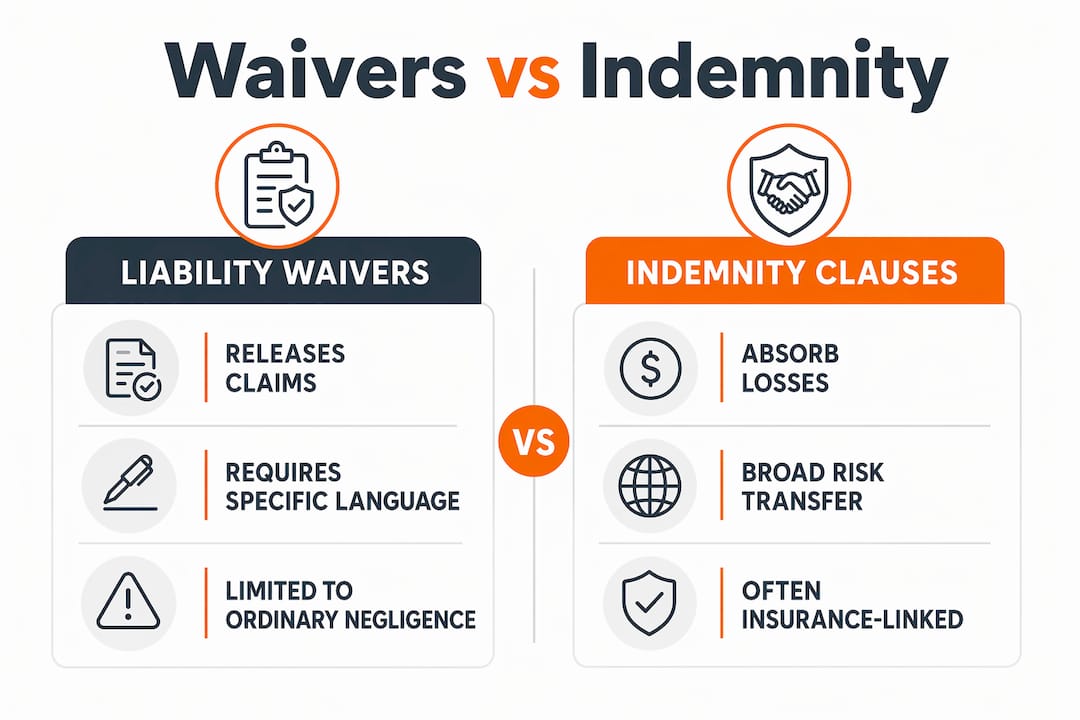
The distinction between ordinary negligence and gross negligence matters just as much. Waivers covering ordinary negligence may be enforceable in Texas and many other states. Waivers that attempt to release liability for gross negligence, which involves reckless or willful misconduct, are almost universally void as against public policy. No court in the country will enforce a waiver that lets a trucking company escape liability for deliberately dangerous conduct.
The practical enforceability of a waiver also depends on whether it unmistakably covers the specific type of negligence at issue. Courts look at whether the waiver was conspicuous, whether the signing party had a reasonable opportunity to read it, and whether the language was specific enough to put the signer on notice.
Common reasons waivers fail in court include:
Vague language that does not name negligence specifically
Small print or formatting that obscures the waiver’s terms
Waivers that attempt to cover gross negligence or intentional misconduct
Waivers signed under duress or without meaningful opportunity to review
Language that conflicts with state anti-waiver statutes
Pro Tip: Have a transportation attorney review every waiver template your fleet uses at least once per year. State courts update their standards, and a waiver that passed legal review in 2023 may not meet 2026 standards in your jurisdiction.
How do indemnity clauses and waivers of subrogation differ from liability waivers?
Trucking contracts routinely include three distinct risk-shifting tools: liability waivers, indemnity clauses, and waivers of subrogation. Each operates differently, and each carries its own legal risks.
Tool | What it does | Key legal risk |
Liability waiver | Releases one party from claims by the other | Fails if language is vague or covers gross negligence |
Indemnity clause | Requires one party to cover the other’s losses | Voided by anti-indemnity statutes in many states |
Waiver of subrogation | Prevents an insurer from suing a third party after paying a claim | Must be endorsed on the policy to be effective |
Indemnity clauses, also called hold harmless clauses, require one party to absorb losses that arise from the other party’s actions. These are common in shipper-carrier agreements and broker contracts. The problem is that anti-indemnity statutes in 46 states limit or void indemnity clauses that attempt to shift liability for another party’s own negligence. That is not a minor footnote. It means that a clause your contract relies on for protection may be legally worthless before the ink dries.
A waiver of subrogation works differently. This insurance endorsement prevents an insurer from pursuing a third party after paying out a claim on your behalf. It is commonly required in commercial trucking contracts to preserve business relationships and reduce litigation between parties in the same supply chain. Without the endorsement on the actual policy, the contractual waiver of subrogation may not bind the insurer.
The connection between indemnity clauses and insurance coverage is where fleet owners face the most hidden risk. Insurance endorsement wording defining “insured contract” status determines whether indemnity obligations are covered or denied. If a state’s anti-indemnity statute voids the underlying clause, the related insurance coverage may also be limited or denied. That means the fleet owner ends up with neither contractual protection nor insurance coverage for the same loss.
Pro Tip: Before signing any contract with an indemnity clause, send it to your insurance broker alongside the contract. Ask specifically whether the indemnity obligation qualifies as an “insured contract” under your current policy. Do not assume it does.
What are the practical implications of liability waivers for trucking businesses?
The practical stakes of trucking liability releases go well beyond contract drafting. How your fleet handles waivers after an accident is just as important as how you draft them before one.
Treat every settlement release as a final rights transfer. A signed general release after a trucking accident settlement is treated by courts as a binding contract. Reopening a settled claim is possible only in rare cases involving fraud or coercion. Arguing that the settlement amount was too low is not enough. Once signed, the release is final.
Never accept an early settlement offer without legal review. Early signing of releases after a trucking crash can permanently waive future claims, including claims for injuries that worsen over time. Practitioners consistently warn that full and final release language must be reviewed before acceptance. A settlement that looks fair on day one can be catastrophically inadequate six months later when a spinal injury requires surgery.
Build a formal internal review process for waivers. Every waiver your fleet presents to drivers, vendors, or contractors should go through a defined review step before it is signed. That process should include a legal review of the language, a check against current state law, and a confirmation that the waiver does not attempt to cover gross negligence.
Account for the 2026 Supreme Court ruling in your broker contracts. The U.S. Supreme Court’s 2026 ruling in Montgomery v. Caribe Transport II limits freight brokers’ ability to use broad federal preemption defenses. State law negligent hiring claims against brokers now survive federal preemption challenges. That ruling directly affects how risk-shifting contracts between carriers and brokers function, and it means broad indemnity clauses in broker agreements face new legal scrutiny.
Document every waiver interaction. Keep records of when a waiver was presented, who signed it, and what opportunity the signer had to review it. Courts look at the circumstances of signing, not just the document itself. A well-documented process strengthens enforceability. A waiver handed to a driver at the last minute with no time to read it is a waiver that may not hold up.
For a broader view of how motor carrier liability intersects with these documents, fleet operators should review the full legal framework before relying on any single waiver as their primary protection.
How do FMCSA regulatory waivers and trailer interchange agreements fit in?
FMCSA regulatory waivers are a separate category from personal injury liability waivers. They do not release claims between private parties. Instead, they temporarily suspend specific federal compliance requirements for defined trucking operations.
Waiver type | Issued by | Purpose | Example |
Regulatory waiver | FMCSA | Suspends specific compliance rules temporarily | 2026 fertilizer hauling HOS waiver |
Liability waiver | Private parties | Releases injury or damage claims | Driver pre-injury release |
Trailer interchange agreement | Private parties | Allocates damage responsibility between carriers | Damage liability on borrowed trailers |
The FMCSA 2026 temporary waiver for fertilizer hauling operations allows certain carriers to bypass hours-of-service and ELD requirements under specific conditions. The waiver still requires documentation and imposes operational rules. It relaxes regulatory compliance obligations without touching civil liability between parties.
Trailer interchange agreements operate closer to traditional liability waivers in their practical effect. Written trailer interchange agreements allocate responsibility for damage and trigger insurance coverage when a carrier uses another carrier’s trailer. Verbal arrangements create coverage gaps. These agreements function as legal risk management tools by defining which party bears the cost when a borrowed trailer is damaged. Without a written agreement, the question of who pays becomes a dispute rather than a settled contractual obligation.
Fleet owners who operate under trailer interchange arrangements should treat those agreements with the same legal rigor as any liability waiver. The cargo liability implications of poorly drafted interchange agreements can be substantial, particularly when a damaged trailer triggers a claim that neither carrier’s insurer wants to cover.
Key takeaways
Liability waivers in trucking only protect your fleet when they are drafted with specific negligence language, reviewed against current state law, and paired with the right insurance endorsements.
Point | Details |
State law controls enforceability | Waivers must meet state-specific standards; Texas requires explicit negligence language to hold up in court. |
Gross negligence voids most waivers | No state enforces waivers that attempt to release liability for reckless or willful misconduct. |
Indemnity clauses face statutory limits | Anti-indemnity statutes in 46 states can void clauses that shift liability for another party’s negligence. |
Settlement releases are final | A signed general release closes a trucking claim permanently, with very limited exceptions for fraud or coercion. |
Insurance endorsements must match contracts | If an indemnity clause is voided by state law, related insurance coverage may also be denied. |
The part of waiver strategy most fleet owners skip
The trucking industry treats liability waivers as paperwork. That is the real problem. After years of watching fleet operators sign contracts with indemnity clauses their insurers will not cover and waivers their state courts will not enforce, the pattern is clear. The document is not the protection. The process around the document is.
Most waivers I have seen in trucking operations are templates pulled from the internet or copied from a competitor’s contract. They are rarely reviewed against the specific state where the work is performed. They almost never account for the difference between ordinary and gross negligence. And they are almost always presented to drivers or vendors in conditions that a court would find coercive or rushed.
The Montgomery v. Caribe Transport II ruling in 2026 changed the risk calculation for broker contracts specifically. Freight brokers can no longer rely on broad federal preemption to kill state negligent hiring claims. That means the indemnity clauses carriers signed with brokers, assuming federal law would protect the broker, now expose carriers to claims they thought were covered. If your broker contracts have not been reviewed since that ruling, they need to be.
The other thing most fleet owners miss is the insurance side. A waiver of subrogation in a contract does nothing if the endorsement is not on the policy. An indemnity clause does nothing if the insurer classifies the obligation outside the “insured contract” definition. The contract and the policy have to match. When they do not, the fleet owner pays twice: once for the claim, and once for the legal fight over who should have paid.
Waivers are worth using. They are not worth overusing. The fleet operators who manage liability well treat waivers as one layer in a broader risk structure that includes proper insurance coverage, legal review of every contract, and documented processes for how waivers are presented and signed.
— Guyorguy
How Insuaria supports trucking fleet liability preparation
Trucking businesses face a layered set of legal and insurance obligations, and liability waivers sit at the center of that complexity. Insuaria is a compliance-first insurance intake and referral platform that helps fleet operators organize the information licensed insurance professionals need to review their coverage.
Through Insuaria’s trucking intake process, fleet owners can submit details about their operations, contracts, and coverage needs in a structured format before a licensed agency partner follows up. Insuaria does not provide insurance advice or bind coverage. Licensed professionals handle all coverage decisions. For fleet operators who want to get organized before that conversation, Insuaria’s business intake form is the right starting point. Review Insuaria’s terms and conditions to understand exactly how the platform works before you submit.
FAQ
What is a liability waiver in trucking?
A liability waiver in trucking is a signed document in which one party gives up the right to pursue legal claims against another for injuries or damages. These waivers appear in driver agreements, shipper contracts, and post-accident settlement releases.
Can a trucking liability waiver cover gross negligence?
No. Courts across the United States treat waivers that attempt to release liability for gross negligence as void against public policy. Only waivers covering ordinary negligence have a realistic chance of being enforced.
What happens if I sign a settlement release too early?
Signing a release after a trucking accident permanently closes the claim in nearly all circumstances. Practitioners warn that injuries can worsen over time, so legal review before signing is critical to avoid waiving future claims.
How does a waiver of subrogation differ from a liability waiver?
A waiver of subrogation is an insurance endorsement that prevents your insurer from suing a third party after paying your claim. A liability waiver is a contract between private parties releasing injury or damage claims. Both serve risk management purposes but operate through entirely different legal mechanisms.
Are indemnity clauses in trucking contracts always enforceable?
No. Anti-indemnity statutes in 46 states limit or void indemnity clauses that attempt to shift liability for another party’s own negligence. Fleet owners should verify enforceability in every state where they operate before relying on these clauses.
Recommended
Comments