
Surety Bonds in Trucking: A 2026 Compliance Guide


TL;DR:
A surety bond in trucking is a three-party guarantee ensuring freight brokers meet their contractual obligations to carriers and shippers. Maintaining a $75,000 bond or trust fund is mandatory for compliance, with strict rules on replenishment and cancellation to prevent suspension. Unlike insurance, bonds guarantee performance and involve personal liability, making regular monitoring essential for operational security.
A surety bond in trucking is a three-party financial guarantee that a freight broker will fulfill payment and contractual obligations to carriers and shippers. Explaining surety bonds in trucking matters more than ever in 2026, because the Federal Motor Carrier Safety Administration (FMCSA) has tightened enforcement timelines and suspension triggers. If you operate as a freight broker or freight forwarder, you are legally required to maintain a $75,000 bond or trust fund at all times. This guide breaks down what that means, how it differs from commercial trucking insurance, and what you need to do to stay compliant and competitive.
What are the regulatory requirements for surety bonds in trucking?
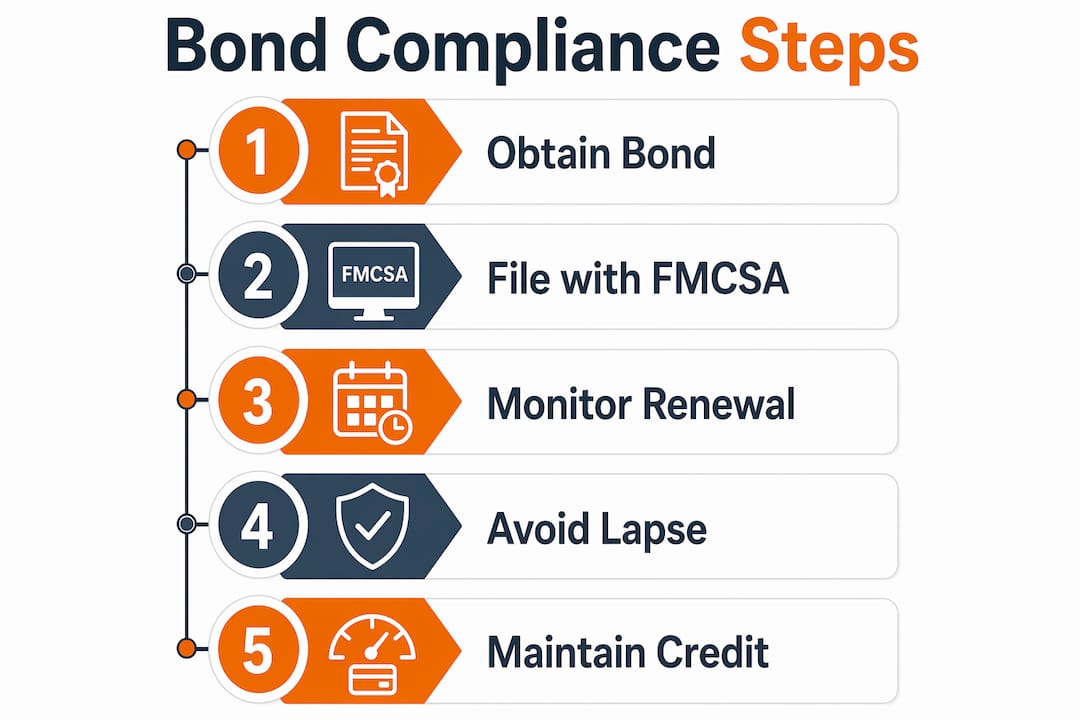
Freight brokers and forwarders must maintain a $75,000 surety bond (BMC-84) or a trust fund (BMC-85) to hold active federal operating authority. This is not optional. The FMCSA treats this requirement as a baseline condition of doing business, not a formality.
Here is how the compliance process works in practice:
File the correct form. You submit either a BMC-84 (surety bond) or a BMC-85 (trust fund) with the FMCSA. Both satisfy the $75,000 minimum financial responsibility requirement. The BMC-84 is issued by a licensed surety company. The BMC-85 is a trust fund arrangement you establish directly.
Maintain the full balance. If a claim is paid against your bond and the balance drops below $75,000, you must replenish it. Under FMCSA enforcement rules effective january 16, 2026, failure to replenish a depleted bond triggers automatic suspension of your operating authority after just 7 days.
Understand cancellation rules. Your surety company must give the FMCSA 30 days’ advance written notice before canceling your bond. That window exists to give you time to replace coverage. If you miss it, your authority goes dark.
Monitor your bond status actively. The FMCSA’s Licensing and Insurance (L&I) system reflects bond status in real time. Shippers and carriers can check your authority status there. A lapse is visible immediately.
Know the difference between BMC-84 and BMC-85. A surety bond (BMC-84) involves a third-party surety company that underwrites your risk. A trust fund (BMC-85) requires you to deposit cash or securities directly. Most brokers use the BMC-84 because it requires less upfront capital, though it comes with ongoing premium costs.
The consequence of a bond lapse is severe. Failure to maintain the required bond leads to automatic suspension of your operating authority. That means you cannot legally broker freight until the bond is reinstated and the FMCSA confirms the restoration.
Pro Tip: Set a calendar reminder 60 days before your bond renewal date. Surety companies can take time to process renewals, and a gap of even one day can trigger a suspension notice with the FMCSA.
How is a surety bond different from trucking insurance?

Surety bonds and insurance serve fundamentally different purposes. Insurance covers accidental losses and protects your business. A surety bond guarantees your performance and protects the people you do business with.
Think of it this way. If your truck is involved in a cargo accident, your commercial trucking insurance pays for the damage. If you fail to pay a carrier for a completed load, the carrier files a claim against your surety bond. Two completely different problems, two completely different tools.
Feature | Surety bond | Commercial trucking insurance |
Who it protects | Third parties (carriers, shippers) | The business itself |
What it covers | Contractual and payment obligations | Accidental losses, liability, cargo damage |
Structure | Three-party agreement | Two-party agreement |
Claims reimbursement | Principal must repay the surety | Insurer absorbs the loss (within policy terms) |
Required by FMCSA | Yes, for brokers and forwarders | Yes, for carriers (separate requirements) |
Carriers and brokers often must maintain both surety bonds and commercial insurance to meet legal and contractual demands. Bonds demonstrate financial credibility. Insurance covers operational risks. Neither replaces the other.
The most common misconception is that a surety bond acts like an insurance policy for the broker. It does not. The bond is a credit instrument. If the surety pays a claim on your behalf, you owe that money back in full, plus legal fees. You are not protected from the loss. You are simply given time to settle it.
Pro Tip: When reviewing your trucking insurance requirements, treat your surety bond and your commercial policies as two separate compliance checklists. Confusing them is how brokers end up underprotected in one area and overpaying in another.
Who are the parties in a surety bond agreement?
A surety bond is a three-party contract involving the principal, the surety, and the obligee. Each party has specific obligations, and understanding them prevents costly surprises.
The principal is the freight broker or forwarder who purchases the bond. You are the principal. You pay the premium, you are bound by the bond’s terms, and you are responsible for reimbursing the surety if a claim is paid. The bond does not protect you. It obligates you.
The surety is the licensed insurance or bonding company that underwrites and issues the bond. The surety evaluates your financial strength, credit history, and industry experience before agreeing to back you. If a valid claim is filed, the surety pays the obligee up to the bond limit. Then it comes after you for repayment.
The obligee is the party the bond protects. In trucking, the obligee is typically the FMCSA, a carrier, or a shipper. The FMCSA requires the bond as a condition of your operating authority. Carriers and shippers benefit from it when a broker defaults on payment or fails to perform.
The financial mechanics matter here. A surety bond functions as a line of credit for the principal. When the surety pays a claim, it is not absorbing a loss. It is advancing funds on your behalf. You must repay the full claim amount plus any legal costs the surety incurred. This is why bond claims can be financially devastating for brokers who are not prepared.
Underwriters set your premium based on how risky you appear as a principal. The premium cost depends on your creditworthiness, financial record, and industry experience. A broker with strong credit and years of clean operating history pays a lower premium than a new entrant with limited financial documentation. This is the surety’s way of pricing the probability that it will need to pay a claim on your behalf.
What are the practical impacts of surety bonds on your trucking business?
Surety bonds affect your business in four concrete ways: your ability to operate legally, your credibility with clients, your cost structure, and your exposure to financial liability.
Operating authority and legal compliance
You cannot broker freight in the United States without a valid bond on file with the FMCSA. Brokers cannot operate without filing and maintaining the required surety bond or trust fund. Authority revocation is the result of noncompliance. This is not a fine or a warning. Your business stops.
Credibility with shippers and carriers
Shippers and carriers check FMCSA records before doing business with a broker. An active, clean bond signals that you are financially responsible and compliant. A lapsed or suspended bond signals the opposite. In a competitive freight market, your bond status is part of your reputation.
Premium costs and personal guarantees
Underwriters focus on creditworthiness and experience when pricing surety bonds. Maintaining good financial health lowers your premium costs over time. Beyond your business credit, bonds frequently require personal guarantees from business owners. This means your personal assets can be at risk if a large claim is filed and the business cannot repay the surety.
What happens when a claim is filed
A claim against your bond is not like an insurance claim. The surety investigates, and if the claim is valid, it pays the carrier or shipper. Then it pursues you for full reimbursement. Legal fees add up quickly. A single unpaid carrier invoice that escalates to a bond claim can cost you two to three times the original amount by the time legal costs are factored in.
Risk factor | Impact on your bond | What to do |
Poor credit score | Higher premium, possible denial | Build credit before applying |
Bond claim history | Surety may not renew | Resolve disputes before they escalate |
Bond balance depletion | 7-day replenishment window | Monitor balance monthly |
Bond cancellation | 30-day FMCSA notice required | Replace coverage before cancellation date |
Pro Tip: Review your role of insurance in logistics annually alongside your bond renewal. Changes in your freight volume or carrier relationships can affect both your bond exposure and your commercial insurance needs at the same time.
Key takeaways
A surety bond in trucking is a legal and financial requirement that protects carriers and shippers, not the broker, and any lapse in coverage triggers immediate suspension of operating authority.
Point | Details |
$75,000 minimum bond | FMCSA requires BMC-84 or BMC-85 for all active freight brokers and forwarders. |
Bond is not insurance | Bonds guarantee your performance; insurance covers your losses. You need both. |
Claims cost you directly | If the surety pays a claim, you must repay the full amount plus legal fees. |
7-day replenishment rule | A depleted bond must be restored within 7 days or your operating authority is suspended. |
Credit drives your premium | Strong personal and business credit lowers your bond cost over time. |
Why most brokers misread their bond until it costs them
I have seen freight brokers treat their surety bond like a checkbox. They file the BMC-84, pay the annual premium, and forget about it until renewal. That approach works fine until a carrier dispute escalates, a bond claim gets filed, and the broker discovers for the first time that they personally owe the surety company tens of thousands of dollars.
The part that catches people off guard is the personal guarantee. Most brokers sign it without fully understanding what it means. It means the surety can come after your personal bank account, not just your business assets, if the business cannot cover the claim. That is a meaningful exposure, and it rarely gets explained clearly at the time of purchase.
My honest recommendation is to treat your bond the way you treat your most important carrier relationship. Check its status regularly. Know your balance. Know your renewal date. And if you are growing your brokerage, talk to your surety company before your freight volume increases significantly. A larger book of business means larger potential claims, and your bond limit may need to reflect that.
The 2026 FMCSA enforcement updates have made the margin for error smaller. The 7-day replenishment window is tight. The 30-day cancellation notice sounds generous until you are scrambling to find a new surety company in the middle of a busy shipping season. Build your compliance process around the assumption that things will go wrong at the worst possible time, because in trucking, they often do.
One more thing worth saying directly: surety bonds are proof of financial credibility to regulators and clients, not protection against losses. The brokers who understand that distinction run tighter operations, maintain better credit, and pay lower premiums year over year. The ones who treat it as just another compliance cost tend to find out the hard way what the bond actually does.
— Guyorguy
How Insuaria helps trucking businesses get bonding and insurance right
Insuaria is a compliance-first intake and referral platform built for trucking businesses that need to get their insurance and bonding documentation organized before speaking with a licensed professional. If you are a freight broker, carrier, or fleet operator trying to sort out your surety bond requirements alongside your commercial trucking coverage, Insuaria makes that first step faster and less confusing.
Through simple intake forms, Insuaria helps you submit the details a licensed insurance professional may need to review your coverage situation. Start your fleet insurance intake today and let a licensed agency partner follow up with options tailored to your operation. Insuaria does not bind coverage or issue quotes. All coverage decisions are handled by licensed professionals.
FAQ
What is a surety bond in trucking?
A surety bond in trucking is a three-party financial guarantee that a freight broker will meet its payment and contractual obligations to carriers and shippers. The FMCSA requires freight brokers and forwarders to maintain a $75,000 bond (BMC-84) or trust fund (BMC-85) as a condition of operating authority.
How much does a freight broker surety bond cost?
The premium depends on your credit score, financial history, and industry experience. Brokers with strong credit pay a lower percentage of the $75,000 bond amount annually, while new entrants or those with weaker financials pay more.
What happens if my surety bond lapses?
The FMCSA will suspend your operating authority. Under 2026 enforcement rules, a depleted bond must be replenished within 7 days, and a canceled bond requires 30 days’ advance notice to the FMCSA before the cancellation takes effect.
Do I need both a surety bond and trucking insurance?
Yes. A surety bond covers your contractual obligations to third parties. Commercial trucking insurance covers your operational risks, including cargo damage, liability, and accidents. Both are required to operate legally and securely in the freight industry.
Can a surety bond claim affect me personally?
Yes. Most surety bonds require a personal guarantee from the business owner. If the surety pays a claim and your business cannot repay it, the surety can pursue your personal assets for the full amount plus legal fees.
Recommended
Comments