
Service Business Liability Coverage Guide for 2026


TL;DR:
Service business liability coverage includes insurance for bodily injury, property damage, and financial harm from operations. Most owners need both commercial general liability and professional liability insurance to address different risks. Proper documentation, timely claims reporting, and understanding policy types are essential for comprehensive coverage and contractual compliance.
Service business liability coverage is defined as insurance protection against claims of bodily injury, property damage, and financial harm arising from your service operations. Every service business owner needs to understand two primary policy types: commercial general liability (CGL) and professional liability insurance, also called errors and omissions (E&O). Together, these form the foundation of any solid business liability insurance guide. Certificates of insurance and endorsements are the key documentation tools that prove your coverage to clients and regulators. Getting these right from the start protects your revenue, your contracts, and your reputation.
What are the essential types of liability coverage for service businesses?
Commercial general liability and professional liability cover fundamentally different risks, and confusing the two is one of the most expensive mistakes a service business owner can make. CGL handles physical incidents. Professional liability handles financial harm. Most service businesses need both.
Commercial general liability (CGL)
CGL covers third-party bodily injury, property damage, and advertising injury. If a client trips over your equipment at their office, CGL pays for their medical bills and any resulting lawsuit. If your crew accidentally damages a client’s property while on-site, CGL responds. This coverage is the baseline for nearly every service contract requirement you will encounter.

CGL does not cover financial losses caused by your professional mistakes. A cleaning company that floods a client’s server room faces a property damage claim covered by CGL. A marketing consultant who delivers a campaign that loses a client money faces a financial harm claim that CGL will not touch.
Professional liability insurance (e&o)
Professional liability insurance, the standard industry term for what many call E&O coverage, protects you when a client claims your service caused them a financial loss. Accountants, IT consultants, architects, and staffing agencies all face this exposure daily. Service providers that purchase only one liability type risk having no coverage for their actual claim exposures.
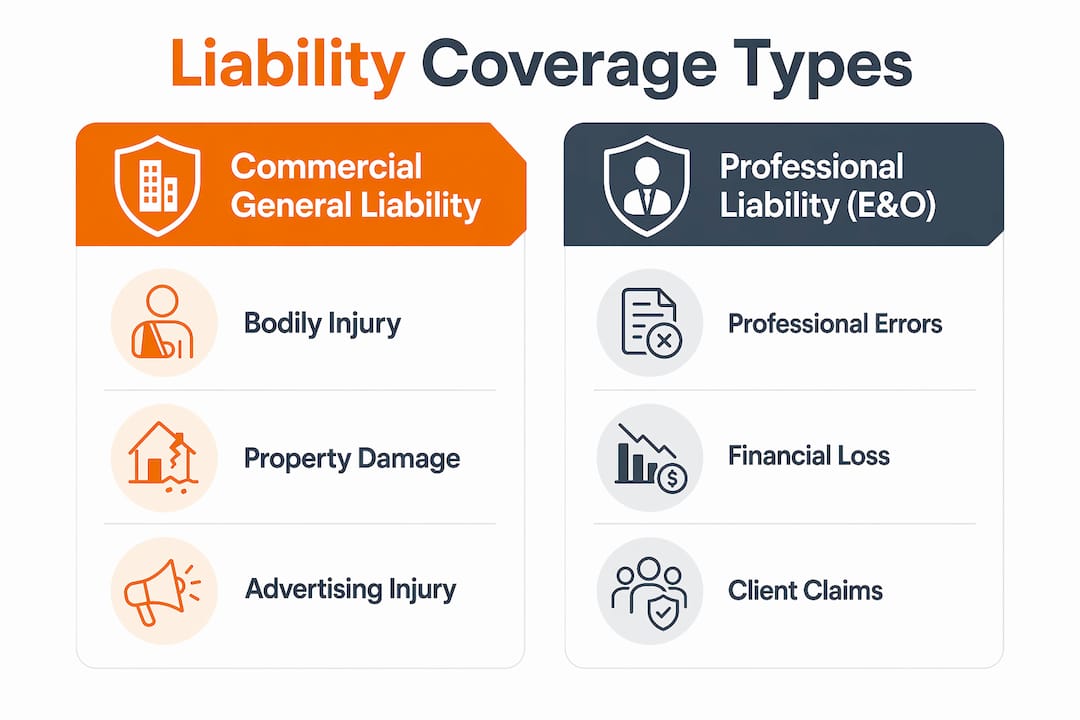
The cost of professional liability is more accessible than many owners expect. Many small service business owners pay less than $1,000 annually for professional liability coverage. That figure puts meaningful protection within reach for sole proprietors and small firms alike.
CGL vs. professional liability: a quick comparison
Feature | Commercial General Liability | Professional Liability (E&O) |
Covers bodily injury | Yes | No |
Covers property damage | Yes | No |
Covers financial harm from errors | No | Yes |
Typical policy form | Occurrence | Claims-made |
Who needs it | All service businesses | Advice or service-based businesses |
Pro Tip: If your service involves both physical work on-site and professional advice, assume you need both policies. A single-policy approach leaves a gap that a determined plaintiff’s attorney will find.
How do you choose the right liability policy structure?
Selecting the right structure for your service industry liability coverage requires understanding how each policy form triggers coverage. The two forms are occurrence and claims-made, and they behave very differently when a claim surfaces years after the work was done.
Occurrence vs. claims-made: what actually matters
Occurrence-based general liability policies protect incidents that occurred during the policy period, even if the claim is filed years later. You can cancel an occurrence policy and still be covered for incidents that happened while it was active. This makes occurrence-form CGL relatively forgiving for business owners who switch insurers.
Professional liability policies almost always use the claims-made form. Coverage applies only when both the incident and the claim fall within the active policy period, unless you purchase tail coverage. This distinction matters enormously when you retire a policy or change carriers.
Retroactive dates and tail coverage
A retroactive date is the earliest date from which your claims-made policy will cover incidents. Claims-made policy details, including retroactive dates and limit structures, directly determine whether a claim is eligible for coverage. If your retroactive date is set to your policy start date, any work you did before that date is unprotected.
When you switch insurers or stop carrying professional liability, you need an extended reporting period, commonly called tail coverage. Tail coverage lets you report claims after the policy ends for incidents that occurred while it was active. Without it, a claim filed six months after your policy lapses is simply uncovered.
How to determine the right coverage limits
Follow these steps to set limits that actually protect you:
Review every active contract. Clients and government agencies often specify minimum limits. A $1 million per-occurrence requirement is common in commercial service contracts.
Assess your largest single-project exposure. If one project failure could cost a client $500,000, your professional liability limit should exceed that figure.
Check your industry’s standard. IT consultants, healthcare staffing firms, and engineering services each carry different typical limits. Ask a licensed broker what is standard in your sector.
Factor in defense costs. Many professional liability policies include defense costs within the limit. A $1 million limit that pays $400,000 in legal fees leaves only $600,000 for a settlement.
Revisit limits annually. Revenue growth, new service lines, and new contracts all change your exposure profile.
Additional insured endorsements and cois
A certificate of insurance (COI) is an informational document. Contracts typically require both a COI and policy endorsements for additional insured coverage to be valid. Handing a client a COI without the matching endorsement does not satisfy most contract requirements, even if the COI lists them as an additional insured.
Pro Tip: Read the insurance requirements section of every contract before you bind coverage. Some contracts require “ongoing and completed operations” additional insured status, which requires a specific endorsement form. Standard endorsements may not cover completed operations.
What documentation and verification steps are crucial for compliance?
Insurance compliance for service businesses goes well beyond keeping a PDF of your policy on file. Relying solely on COIs creates false security in insurance compliance. Verifying endorsements is what actually meets contractual obligations.
Cois vs. endorsements: know the difference
A COI summarizes your coverage. An endorsement modifies your policy to add a specific party as an additional insured. These are not interchangeable. A COI can state that a party is listed as additional insured, but without the actual endorsement on file, that party has no enforceable coverage rights under your policy.
Additional insured endorsements must be reviewed for coverage scope, including whether they cover ongoing operations, completed operations, or both, and must match the exact legal name specified in the contract. A mismatch between the contract name and the endorsement name is a compliance failure that can void coverage at the worst possible moment.
Insurance compliance verification checklist
Use this checklist before signing any service contract or starting any project:
Obtain the COI from your insurer and confirm all policy numbers, effective dates, and limits are accurate.
Request the additional insured endorsement form and confirm it matches the contract’s required language.
Verify the endorsement covers the correct scope: ongoing operations, completed operations, or both as required.
Confirm the legal name of the additional insured on the endorsement matches the contract exactly.
Check that your professional liability retroactive date predates the start of the engagement.
File copies of both the COI and all endorsements in a dedicated compliance folder, organized by client and contract.
Set a calendar reminder 60 days before policy renewal to update all active COIs and endorsements.
Thorough endorsement review is what separates genuine compliance from the appearance of compliance. Merely having certificates on file does not satisfy ongoing and completed operations coverage requirements under most commercial contracts.
Pro Tip: Ask your insurer to send endorsements directly to your clients when required. This removes the risk of you forwarding an outdated or incorrect document.
How do you manage claims, renewals, and coverage pitfalls?
Claims management and policy continuity are where many service businesses lose coverage they thought they had. The rules are strict, and the consequences of missing them are permanent.
Report claims immediately, without exception
Professional liability claims reporting requires immediate action on any potential claim before your policy expires. This is not a suggestion. Under a claims-made policy, a claim you knew about but failed to report before expiration is an uncovered claim. Period.
Follow these steps for disciplined claims reporting:
Document the incident the day it occurs. Write down dates, parties involved, and the nature of the potential claim.
Notify your insurer in writing immediately. Do not wait to see if the client actually files a formal complaint.
Preserve all related communications. Emails, contracts, and project notes are your defense record.
Confirm receipt from your insurer. Get written acknowledgment that your notice was received and logged.
Do not discuss liability with the claimant. Route all communications through your insurer or legal counsel.
Managing policy renewals and tail coverage
Extended reporting periods must be purchased within a limited window after policy expiration and do not retroactively cover claims already made during the policy term. This is a critical distinction. If you wait too long after a policy lapses to purchase tail coverage, that option disappears entirely.
“Before you cancel or let a professional liability policy lapse, report every known or suspected claim. Extended reporting periods do not extend deadlines for incidents you already know about.” — Professional Liability Underwriting Society
Common pitfalls that service business owners encounter include:
Letting a claims-made policy lapse without purchasing tail coverage. Any incident from your coverage period that surfaces after the lapse is unprotected.
Assuming a new insurer’s policy covers prior work. Without a matching retroactive date, prior work is excluded.
Missing the endorsement renewal cycle. When you renew your policy, your additional insured endorsements need to be renewed too. Clients holding last year’s endorsement may not have valid coverage under your new policy.
Failing to update limits after revenue growth. A $500,000 professional liability limit that made sense three years ago may be dangerously low today.
Maintaining a strong relationship with your insurer is practical risk management. Insurers who know your business are faster to respond, more likely to offer favorable renewal terms, and better positioned to flag coverage gaps before they become claims.
Key takeaways
Effective service business liability coverage requires combining CGL and professional liability policies, managing documentation precisely, and reporting claims without delay.
Point | Details |
Two policies, not one | CGL covers physical incidents; professional liability covers financial harm from errors. Most service businesses need both. |
Claims-made timing is strict | Report all known or suspected claims before your professional liability policy expires or risk losing coverage permanently. |
COIs alone are not enough | Contracts require matching endorsements, not just certificates, to establish valid additional insured status. |
Tail coverage has a deadline | Extended reporting periods must be purchased promptly after policy expiration; the window closes fast. |
Review limits annually | Revenue growth and new contracts change your exposure; outdated limits leave real gaps in protection. |
What i’ve learned after years of watching service businesses get this wrong
The single most common mistake I see service business owners make is treating liability insurance as a checkbox. They buy a CGL policy because a client asked for it, hand over a COI, and consider the job done. Then a professional liability claim surfaces, and they discover their CGL policy excludes it entirely. That moment of discovery is expensive and avoidable.
The second mistake is misunderstanding what a COI actually is. A certificate of insurance is a snapshot. It tells you what coverage existed at the moment it was printed. It does not guarantee that coverage is still active, that the endorsement matches your contract, or that the limits are adequate. I have seen contracts fall apart at the last minute because a vendor’s COI listed the wrong legal entity name on the additional insured line.
What actually works is treating your liability coverage as a living document. Review it when you sign new contracts. Review it when your revenue grows significantly. Review it when you hire subcontractors, because their work can trigger your liability. And when you are considering switching insurers, talk to a licensed broker about your retroactive date and tail coverage options before you cancel anything.
The best practices for liability coverage are not complicated. They require attention, not expertise. Pair that attention with a knowledgeable licensed broker who specializes in your service sector, and you will avoid the gaps that catch most business owners off guard. You can also review coverage gap patterns across different service industries to understand how these mistakes repeat across sectors.
— Guyorguy
How Insuaria helps you organize your liability coverage process
Managing liability coverage documentation is easier when your information is organized before you talk to a licensed insurance professional. Insuaria is a compliance-first intake and referral platform that helps business owners gather and organize the details a licensed agency partner needs to review your coverage.
Through Insuaria’s business intake process, you can submit your business details in a structured format, making the first step of any insurance review faster and more efficient. Insuaria does not provide insurance advice, bind coverage, or issue quotes. Licensed professionals handle all coverage decisions. To understand the full scope of how the platform works, review the platform terms and conditions before submitting your information.
FAQ
What is the difference between CGL and professional liability?
Commercial general liability covers bodily injury, property damage, and advertising injury from physical incidents. Professional liability covers financial harm caused by errors, omissions, or negligence in your professional services.
Do i need both types of liability insurance?
Most service businesses need both. CGL does not cover financial harm from professional mistakes, and professional liability does not cover physical injury or property damage claims.
What is a claims-made policy and why does it matter?
A claims-made policy covers claims only when both the incident and the claim occur during the active policy period. This makes the timing of claims reporting and the purchase of tail coverage critical for maintaining protection.
Is a certificate of insurance enough to prove coverage?
A COI alone is not sufficient for most contract requirements. Contracts typically require a matching additional insured endorsement that confirms the scope and legal name of coverage, not just a summary certificate.
What happens if i miss a claims reporting deadline?
Under a claims-made professional liability policy, a claim you knew about but failed to report before policy expiration is uncovered. Extended reporting periods do not retroactively cover known claims that were not reported on time.
Recommended
Comments