
Role of Underwriters in Trucking: 2026 Guide


TL;DR:
Trucking underwriters assess risk factors like driver safety, cargo type, and operational radius to determine coverage terms. Their evaluations influence premiums, coverage limits, and fleet operational legality, emphasizing the importance of proper data and compliance. Proactive communication and organization can improve underwriting outcomes and ensure continuous fleet operation.
Trucking underwriters are the professionals who decide whether your fleet gets covered, at what price, and under what terms. The role of underwriters in trucking goes far beyond rubber-stamping a policy. These specialists evaluate risk factors including driver experience, loss history, cargo type, operational radius, and FMCSA safety performance before any coverage is bound. Their decisions determine your premium, your coverage limits, and in some cases, your ability to legally operate. Fleet managers who understand how underwriters think are better positioned to negotiate favorable terms and avoid costly surprises at renewal.
What is the role of underwriters in trucking insurance?
Trucking insurance underwriters are risk analysts employed by insurance carriers. Their job is to evaluate a commercial fleet submission and decide three things: whether the carrier will accept the risk, what terms apply, and what the premium will be. Every trucking policy starts with this gatekeeping function.
Underwriting is an actuarial exercise. It estimates expected loss frequency, severity, and catastrophic tail risk across a fleet’s operations. That means underwriters are not simply checking whether your trucks are roadworthy. They are modeling the probability and cost of future claims based on your entire operational profile.
One terminology note worth clarifying: the word “carrier” means two different things in this industry. In trucking operations, a carrier is a motor carrier hauling freight. In insurance, a carrier is the company issuing the policy. Underwriters work for insurance carriers. Keeping that distinction clear prevents confusion when reviewing policy documents or speaking with your broker.
The importance of trucking underwriters extends to regulatory compliance as well. FMCSA requires motor carriers to maintain specific insurance filings to hold operating authority. Underwriters coordinate those filings, and any lapse can trigger enforcement action. Their work is not just financial. It is operational.
What key factors do trucking underwriters evaluate?
Underwriters tier trucking submissions based on five core operational and behavioral factors. Each factor filters which insurance carriers will consider the submission and sets the parameters for pricing.
Operation type: Long-haul interstate operations carry more exposure than local or regional routes. Specialized operations like hazmat or oversized loads face stricter scrutiny and a narrower pool of willing carriers.
Fleet size and profile: The number of power units, vehicle age, and equipment value all affect risk modeling. Older fleets with deferred maintenance histories raise red flags immediately.
Cargo hauled: Commodity type determines both liability exposure and cargo coverage requirements. Refrigerated goods, electronics, and pharmaceuticals carry higher values and theft risk than bulk commodities.
Radius of operation: A fleet running coast-to-coast faces more exposure than one operating within a 200-mile radius. Underwriters assign risk tiers based on geographic spread.
Safety and CSA performance: Underwriters use FMCSA safety data including CSA BASICs percentiles and Pre-Employment Screening Program (PSP) reports to assess carrier-level and driver-level safety records. High percentile scores in categories like Unsafe Driving or Hours of Service signal elevated risk and directly influence premium calculations.
Beyond these five factors, underwriters also review driver qualification files, motor vehicle records (MVRs), and loss runs covering the prior three to five years. Open claims receive more conservative treatment than closed ones. A fleet with three open claims from the past year will face tighter terms than one with the same number of claims all closed and settled.
Pro Tip: Pull your CSA BASICs scores from the FMCSA Safety Measurement System before submitting to any underwriter. Scores above the 65th percentile in any BASIC category will draw scrutiny. Knowing your numbers in advance lets you address them proactively rather than reactively.
How does the underwriting process work in trucking?
The underwriting process in trucking is document-driven. Commercial underwriting workflows still rely heavily on manual data gathering, and bottlenecks like motor vehicle record ordering and loss run reconciliation create real delays. Submitting complete, accurate, and verifiable data from the start is the single most effective way to accelerate the process.
Underwriters require complete and verifiable data across seven key categories:
Authority and identity: DOT number, MC number, legal entity name, years in operation, and state of domicile.
Fleet details: Number and type of power units, trailers, vehicle identification numbers (VINs), stated values, and maintenance records.
Operations: Lanes operated, percentage of interstate versus intrastate miles, and whether the fleet uses owner-operators or company drivers.
Cargo: Commodity types hauled, average load values, and any hazardous materials designations.
Drivers: Complete driver schedules with license numbers, MVRs, years of CDL experience, and violation history. Underwriters reject incomplete driver lists outright. “Will provide upon request” is not acceptable. This is a hard gating factor.
Safety and compliance: CSA scores, PSP reports, drug and alcohol testing program documentation, and any out-of-service orders.
Loss history: Three to five years of loss runs with open and closed claim status clearly differentiated. Open claims receive more conservative underwriting treatment and higher pricing.
Regulatory filings intersect directly with this process. FMCSA requires motor carriers to maintain BMC-91, BMC-91X, and MCS-90 endorsements as proof of financial responsibility. Underwriters coordinate these filings with the insurer’s compliance team. A gap in filing, even for a single day, can trigger automatic operating authority suspension. That makes filing continuity a core underwriting concern, not just a paperwork formality.
Pro Tip: Organize your loss runs before submission and clearly label each claim as open or closed. Include a brief narrative for any claim over $25,000. Underwriters appreciate context, and it signals that your operation takes risk management seriously.

What impact do underwriters have on costs and fleet operations?
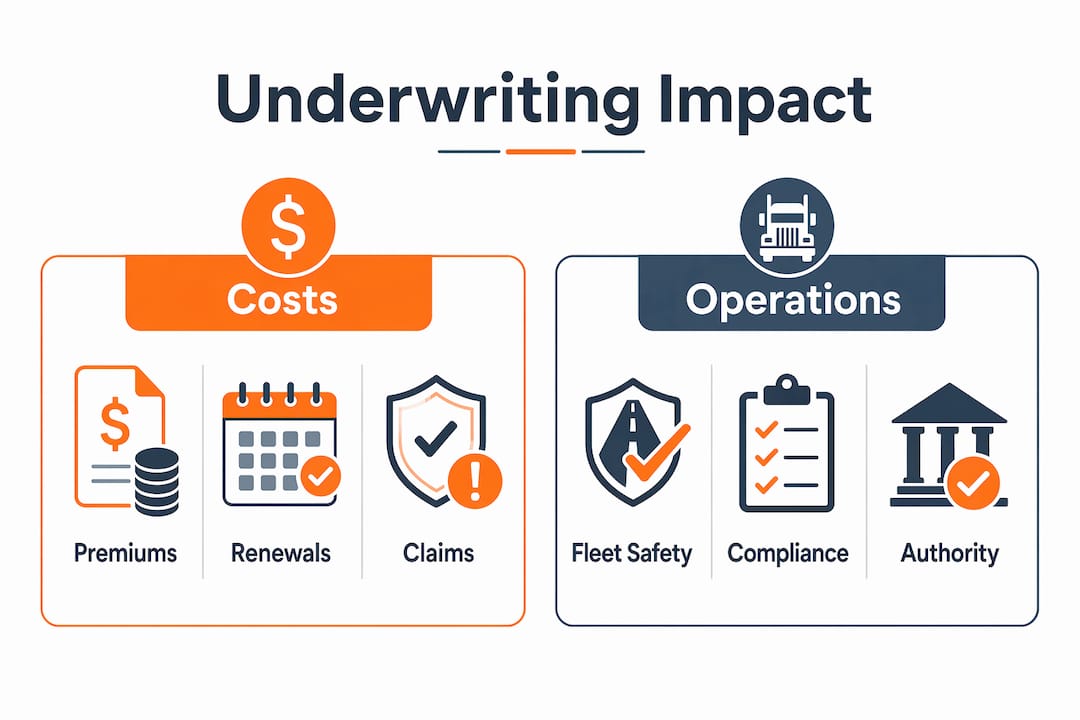
Underwriting decisions shape every line item in your insurance program. The table below shows how specific underwriting outcomes translate into real operational consequences.
Underwriting Factor | Favorable Outcome | Unfavorable Outcome |
Strong CSA scores | Lower base premium, broader carrier appetite | Surcharges, restricted terms, or declination |
Complete driver schedule | Faster approval, accurate rating | Delay or rejection of submission |
Clean loss runs (closed claims) | Standard pricing, full coverage options | Higher premiums, sublimits, or exclusions |
Current FMCSA filings | Operating authority maintained | Authority suspension, forced shutdown |
Stable operations at renewal | Renewal treated as continuation | Re-underwriting from scratch, rate increases |
Underwriters use frequency and severity modeling to set premiums. Frequency refers to how often losses occur across a fleet. Severity refers to the average cost per claim. A fleet with frequent small claims may face higher premiums than one with a single large settled claim, because frequency signals systemic safety problems rather than isolated incidents.
Renewal underwriting deserves special attention. Renewal assessments can change significantly if fleet operations change between policy periods. Adding new lanes, hiring younger drivers, or expanding into new cargo types all alter the risk profile. Underwriters treat material operational changes as triggers for re-underwriting, not simple renewals. Fleets that fail to disclose changes risk policy voidance or coverage gaps at the worst possible moment.
The impact of underwriters on logistics operations is direct and measurable. A fleet that loses its operating authority due to a filing lapse cannot legally move freight. That is not a theoretical risk. It is a business-ending event that underwriting oversight is specifically designed to prevent.
How can fleet managers improve underwriting outcomes?
Preparation before submission is the most effective tool a fleet manager has. Internal audits and pre-submission risk translation can prevent underwriting denial or unfavorable terms. Treat your submission package the way you would treat a loan application. Gaps and inconsistencies signal risk, even when the underlying operation is sound.
Here are the most impactful steps fleet managers can take before engaging with trucking insurance underwriters:
Conduct a driver file audit. Pull every driver’s MVR, verify CDL endorsements, and confirm drug and alcohol testing compliance. Underwriters will find gaps. You want to find them first.
Reconcile your loss runs. Request loss runs from your current carrier at least 60 days before renewal. Review them for accuracy, confirm claim statuses, and prepare brief narratives for large losses.
Review your CSA scores. Use the FMCSA Safety Measurement System portal to check your BASICs percentiles. Scores above the intervention threshold in Unsafe Driving or Controlled Substances will require explanation. Understand how PSP scores affect rates before your underwriter raises the issue.
Document operational changes. If you added trucks, changed lanes, or shifted cargo types in the past 12 months, document those changes clearly. Surprises at underwriting hurt your credibility and your pricing.
Work with a specialized broker. A broker who focuses on commercial trucking knows which carriers have appetite for your operation type. They can pre-screen submissions and prevent wasted time with carriers who will decline on the first pass.
Maintain filing continuity. Even a one-day gap in FMCSA insurance filings triggers automatic authority suspension. Coordinate policy renewals with your broker and insurer at least 30 days in advance to prevent lapses.
The responsibilities of trucking underwriters include evaluating your entire risk profile, but they also include communicating what they need. When an underwriter asks follow-up questions, respond quickly and completely. Delays in responding extend the underwriting timeline and can push your renewal past the policy expiration date.
You can also review insurance requirements for trucking companies to understand the minimum coverage thresholds FMCSA mandates before your underwriter raises them.
Key takeaways
Trucking underwriters control insurance eligibility, pricing, and compliance filings, making their decisions one of the most consequential forces in fleet operations.
Point | Details |
Underwriters set coverage terms | They evaluate driver records, cargo, CSA scores, and loss history before binding any policy. |
Seven data categories are required | Complete submissions covering authority, fleet, operations, cargo, drivers, safety, and loss history prevent delays. |
Filing gaps suspend authority | A single day without valid FMCSA filings can halt your operating authority and shut down freight movement. |
Renewal is not automatic | Operational changes trigger re-underwriting; notify your underwriter of fleet or lane changes before renewal. |
Preparation changes outcomes | Pre-submission audits of driver files and loss runs reduce the risk of declination or unfavorable terms. |
Underwriting is a partnership, not a checkpoint
Most fleet managers treat underwriting as something that happens to them. That framing costs money. After years of watching trucking operations navigate insurance renewals, the pattern is clear: fleets that engage underwriters as partners consistently get better terms than fleets that submit paperwork and wait.
Underwriting is evolving. Carriers are integrating telematics data, electronic logging device records, and real-time CSA monitoring into their risk models. That shift favors fleets with strong data hygiene. If your operation generates clean safety data but you are not sharing it proactively, you are leaving pricing leverage on the table.
The market volatility of the past few years has made renewal underwriting more demanding. Rate spikes in commercial trucking insurance have pushed underwriters to treat renewals as fresh submissions, scrutinizing operational changes that would have passed without comment in a softer market. Fleets that maintain continuous communication with their brokers and underwriters throughout the policy year are far better positioned when renewal season arrives.
The hardest lesson I have seen fleet managers learn is that underwriting is not a one-time event. It is a continuous relationship. Underwriters who know your operation, trust your data, and see evidence of a genuine safety culture will advocate for you internally when pricing decisions are made. Those who only hear from you at renewal have no reason to go to bat for your account.
Treat your underwriter the way you treat your best customer. Communicate proactively, deliver accurate information, and address problems before they become claims. That approach does more for your insurance costs than any single coverage decision.
— Guyorguy
Get your trucking insurance intake right the first time
The underwriting process rewards preparation. Disorganized submissions delay coverage, inflate premiums, and sometimes result in outright declines. Insuaria is built to help trucking businesses organize exactly the information licensed insurance professionals need before the underwriting process begins.
Through Insuaria’s fleet insurance intake process, you can submit your fleet details, driver information, operational data, and loss history in a structured format that makes the underwriting review more efficient. Insuaria does not bind coverage or issue quotes. Licensed agency partners handle all coverage decisions. But getting your information organized before that conversation starts puts your fleet in a stronger position from day one. Start your submission at Insuaria’s trucking intake and take the first step toward a cleaner underwriting outcome.
FAQ
What does a trucking underwriter actually do?
A trucking underwriter evaluates a fleet’s operational, safety, and compliance data to determine insurance eligibility, coverage terms, and premium pricing. Their decision controls whether a policy is issued and at what cost.
What information do underwriters need for trucking insurance?
Underwriters require data across seven categories: DOT and MC authority, fleet details, operations, cargo types, complete driver schedules, CSA and compliance records, and three to five years of loss runs with open and closed claim status.
How do CSA scores affect trucking insurance underwriting?
High CSA BASICs percentiles, particularly in Unsafe Driving or Hours of Service, signal elevated risk and directly increase premiums or reduce carrier appetite for a submission. Scores above the 65th percentile in any BASIC category typically trigger underwriter scrutiny.
What happens if FMCSA insurance filings lapse?
A gap in BMC-91 or MCS-90 filings, even for a single day, triggers automatic operating authority suspension. That means your fleet cannot legally haul freight until the filing is reinstated and FMCSA processes the update.
Can a fleet improve its underwriting outcome before renewal?
Yes. Conducting driver file audits, reconciling loss runs, reviewing CSA scores, and documenting operational changes before submission are all proven methods for improving underwriting terms and avoiding declination.
Recommended
Comments